From simulation model to virtual testbench
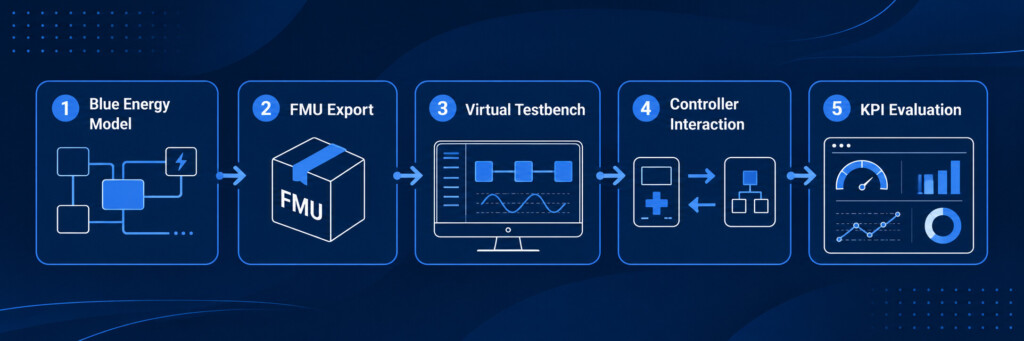
A Blue Energy model describes the physical behaviour of your energy system: generators, consumers, storages, grids, buildings, HVAC equipment, e-mobility infrastructure and control-related interfaces. Exported as an FMU, this model can be coupled with external software, AI algorithms, process controls or PLC hardware.
The FMU provides virtual sensor values and receives control variables from the system under test. This makes it possible to evaluate control behaviour, compare strategies and test edge cases without risk to the real plant.
Typical coupling options
- Software controllers and energy management systems
- AI-based optimization algorithms
- PLCs, DDCs and automation hardware
- Web-based operation and visualization environments
- Scalable simulation frameworks for large variant studies
Software-in-the-Loop testing
Test control algorithms before deployment
Software-in-the-Loop testing connects the Blue Energy FMU to a software controller, such as a Java, Python or cloud-based energy management algorithm. The controller interacts with the simulated energy system as if it were connected to a real plant.
This enables early development and validation of control logic under reproducible conditions. Different controller versions can be tested against the same scenarios, making performance transparent and comparable.
Benefits of SiL testing
- Faster and safer controller development
- Early testing of control functions before field deployment
- Reproducible test conditions for different algorithms
- Evaluation of average, extreme and fault scenarios
- KPI-based comparison of controller performance
- Visualization of benefits such as energy savings, cost reduction or improved operating behaviour
- Automatic parameterization of controllers via the testbench
- Higher-quality algorithms before delivery to end customers
Example applications
- Energy management for industrial sites
- Optimization of heat pumps, CHP units and thermal storages
- Charging and load management for e-mobility
- PV, battery and grid interaction
- Predictive and model-predictive control
- Regression testing after software updates or system extensions
Are you interested in learning more about Software-in-the-Loop testing for your specific application?
Hardware-in-the-Loop testing
Connect real automation hardware to a virtual energy system
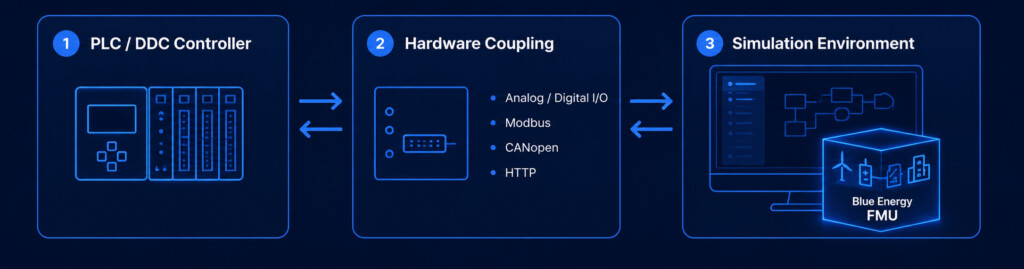
Hardware-in-the-Loop testing connects real controller hardware, such as PLCs or DDCs, to a Blue Energy digital twin. The controller under test exchanges signals with the FMU-based simulation through fieldbus, communication protocols or analog and digital I/O.
This allows control engineers to perform commissioning-like tests at their desk. Control quality, reliability and fault behaviour can be analyzed long before the controller is connected to the actual plant.
Benefits of HiL testing
- Virtual commissioning and early fault detection
- Desk-based controller tests and regression tests
- Reduced on-site commissioning effort
- Safe testing of critical or rare operating conditions
- Analysis of control quality and reliability under multiple scenarios
- Location-independent testing for distributed development teams
- Faster feedback loops for developers
- Increased system quality and customer satisfaction
Example applications
- Creation of new control algorithms during product development
- Continous tests of controller algorithms
- Pre-configuarion of algorithms for specific plants
Are you interested in learning more about Hardware-in-the-Loop testing for your specific application?
Beyond SiL and HiL:
Observer-based control and virtual sensors
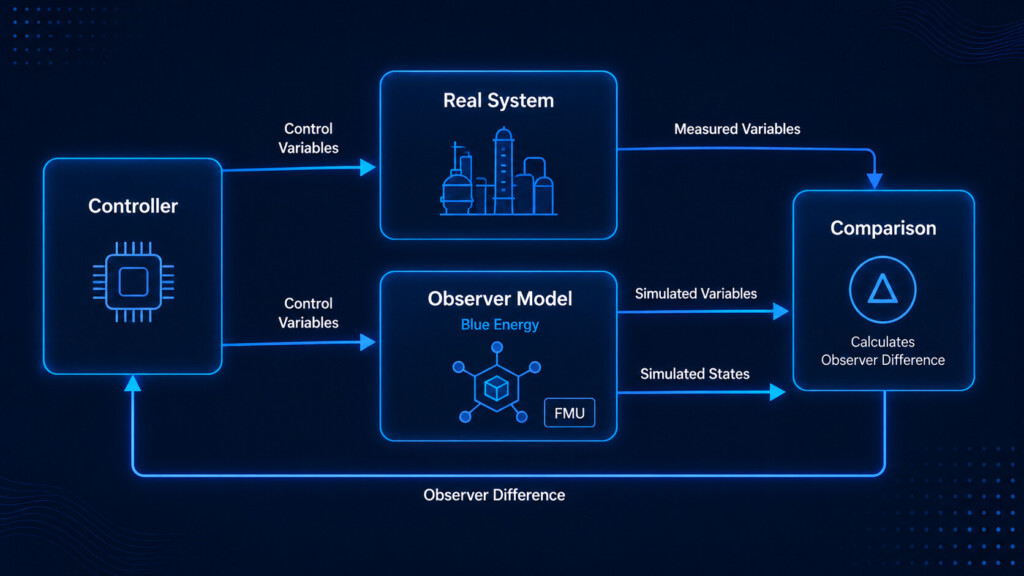
A simulation model can be used as an observer model alongside the real system. By comparing simulated and measured variables, internal states can be estimated that are difficult or impossible to measure directly. This enables advanced control strategies, virtual sensors and deeper insight into system behaviour.
Large-scale variant studies
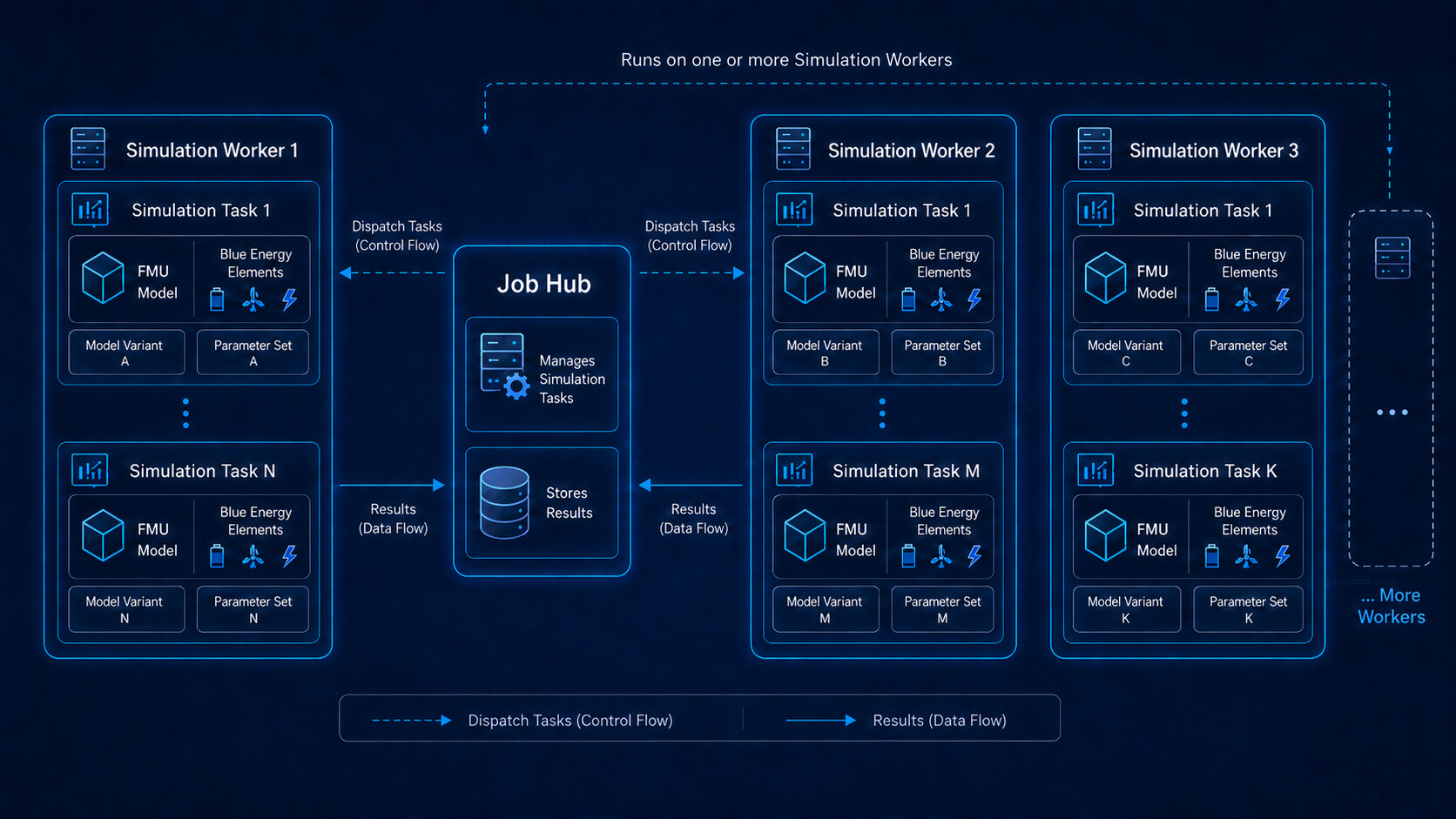
With scalable simulation frameworks, thousands of model variants can be scheduled, simulated and stored. This enables decentralized simulation, parameter studies and systematic comparison of design alternatives across different locations, tariffs, weather data or operating strategies.
Are you interested in learning more about advanced use cases of our Blue Energy models for your specific application?